Thursday, January 5, 2017

Austria, Croatia, and Bosnia

Vienna, Austria:


One of the highlights of my trip was meeting up with my dear friend Kieryn, who is living in Vienna for a few years. This was the first time I’ve seen her since she moved in January, and it was so, so good to see her again. She is interning with a church which has a very diverse congregation and which works closely with the refugee community. It was such a joy to see first-hand the amazing work she is a part of in Vienna. I got into town on Saturday night, just in time to see the action on Sunday!


First up was the Spanish speaking service. I obviously was really excited for this service. I even knew a few of the songs, from my days attending church when I studied in Chile. Next up was Farsi church for members who are refugees from Iran and Afghanistan. Each week a few volunteers from the Farsi congregation prepare a traditional Persian meal for everyone to share, and it was delicious! For the service itself, the pastor preached in English and a man from the congregation translated, so I could understand what was being said. The worship music was beautiful, and even though I didn’t understand most of the lyrics, it was wonderful to witness how passionate these refugees are about their faith, and to be a part of their musical expression of that devotion. At the end of the service, those who were up for asylum decisions with the government raised their hands and we prayed for them to receive favorable decisions. We also prayed for those who are still waiting and hoping that they will receive asylum. I got to meet and speak briefly with a few of the refugees, and they were so friendly. The last service of the day was the German speaking service, which had some English peppered in. Kieryn got to practice her translation skills for me as our friend Mira preached (“Bad Lip Reading by Kieryn”). The congregation had shared a meal before, and we stayed and chatted for a few hours afterward.


It was a long day to be sure, but it was so great to see the work that Kieryn has been doing in Austria over the past year! It was also really impactful for me to meet the refugees I met, because we hear so many (often negative) messages about refugees. I have also been guilty of thinking of refugees in the abstract, and having a chance to interact with them in person made me remember that they are living, breathing humans whose lives really matter, not just political instruments.


By the end of the first month of my journey, I was exhausted and ready for a few days of R&R. I hardly left the apartment for a while other than to run around the castle and palace grounds nearby (casual). Kieryn and I also spent lots of time catching up on months of best friendship, which meant hours and hours of conversation. It was an emotionally intense week, because neither of us is one to just shoot the breeze - we talked at depth about so many weighty issues, and cycled through all of the emotions in a compact time frame. There were lighter moments as well - wine nights with Kieryn’s dear friend Mira; visiting the tourist sites; running through palaces (yes, really, the gardens are open to the public and serve practically as parks now); and taking a break from Kieryn’s applications and my trip planning to sing along to Tina Turner and dance wildly about the flat.


Casual run through palace gardens
 One of the highlights of the week, for me at least, was taco night. Yes, you read that correctly - TACOS! Anyone who has been to Europe knows that they have a surprising dearth of even mediocre Mexican food, and Kieryn and I were born and raised eating lots of Mexican and Tex-Mex food. I had been without it a month, poor Kieryn almost a year, and we had some mighty strong cravings. We came up with the brilliant idea of throwing a party to fulfill the noble vision of bringing tacos to the good people of Vienna. Google helped us find the Mexican import store, so we could go full-out. I’m talking carne cooked in spicy sauce, with corn tortillas and chips, salsa, guacamole, fajita vegetables, beans, and all the other toppings. We even made what we dubbed the “Vienna margarita”: Cuervo tequila, lemon juice, orange juice, Elderflower syrup, and a sprinkle of salt. They tasted pretty damn close to the original. I threw together a playlist of reggaeton, salsa, and other music to get us in the mood, and we were ready! We cooked enough for 30, and maybe had fewer than that show up, but there was a crowd. Many of Kieryn’s friends from the church came, and since their congregation is so international, we had people from all over the world at the party. A few of them had never even had a taco before - in fact, the Iranian women had to Google what a taco was, and they especially enjoyed the meal. Everyone loved the food, and it was a really fun night!


Behold, the beauty of hot sauce, piƱatas, and tacky sombreros
Ironically, after executing such a delicious (and challenging, given the lack of readily available ingredients) meal, the following night we had the ultimate cooking disaster and a reminder that I was still in a foreign country. We intended to make gluten free pasta with red sauce and zucchini. Simple, easy, delicious. Except, all the “alternative” food products were next to each other in the grocery store, and my German being practically non-existent, I picked up what I thought was gluten-free pasta, but which in actuality was vegan “beef” crumbles (the box had a picture of pasta with red “meat” sauce, ok?). I also got a cucumber instead of a zucchini. So we got all the way back to the apartment, hangry, and realized that we had neither of the crucial ingredients for this meal. We laugh-cried - how typical that after being such accomplished cooks, that we would have such a massive failure.


Finally, my week in Vienna was over, and I had to say goodbye to Kieryn. It was a rough re-entry to the traveler’s life for me, for in my early morning haze, I missed my train to the airport while literally sitting at the train station. I realized too late that the train which had just pulled up was my train, and by the time I asked, it was pulling away. So, I had to call Kieryn (who was already halfway back to sleep) and inquire about how to catch a cab. And with that, I was off to Croatia!


Croatia:

Croatia is really beautiful. I was there right at the end of the tourism season, so unfortunately it was a bit too windy and cool to actually swim in the ocean. If I ever return at some point later in life, I’ll have to go during the summer so that I can do the cliff jumping, sea kayaking, and all the other oceanic activities the country is known for!


Even turbulent, the Adriatic Sea is gorgeous

However, I still got to appreciate the nature that Croatia has to offer. I visited Krka National Park for a day to see its beautiful and huge waterfalls. Even though I knew the water would be freezing so late in the season, I just had to take a dip! However, when I went to go ask a woman at one of the snack shops on site to watch my bag while I swam, she panicked. She asked, “You’re going swimming? Swimming?!?” I nodded. “It’s very dangerous! Very dangerous! Something just happened, you really shouldn’t!” She went on to explain that at this point in the year the current was strong if I went far out. I was skeptical, because for some reason as a solo female traveler everyone feels the need to protect me as if I were a small child, and it gets annoying. I walked over to the swimming area, scoped it out, and decided I would just wade in a short distance. She took my backpack and looked at me with as much fear in her eyes as if I had said I’d like to visit a serial killer’s haunted mansion. So I slowly made my way in until I was waist deep, took a few selfies (#basic) and carefully tread back, because the rocks were actually very slippery and slimy. When I went to recollect my things, the woman at the shop exclaimed, “You’re alive!” I thought yep, I’m alive, why are you so surprised? However, I found out on the bus ride back into town that something tragic actually had happened. A young guy had slipped on the rocks, fallen and hit his head, and then drowned because he took in too much water. He was there on vacation with his group of friends. One of my friends from the hostel who had been there earlier in the day actually swam with them before it happened. It was an eerie moment for sure, to realize that even when I like to think I’m a bold and independent adventurer, that in one tragic moment everything can go wrong.


Fun fact: A lot of Game of Thrones was filmed in Croatia! The combination of scenery and ancient towns makes for a breathtaking backdrop. Confession: I'm way behind on the show, but Google let me know where things were filmed.
Dubrovnik, aka King's Landing


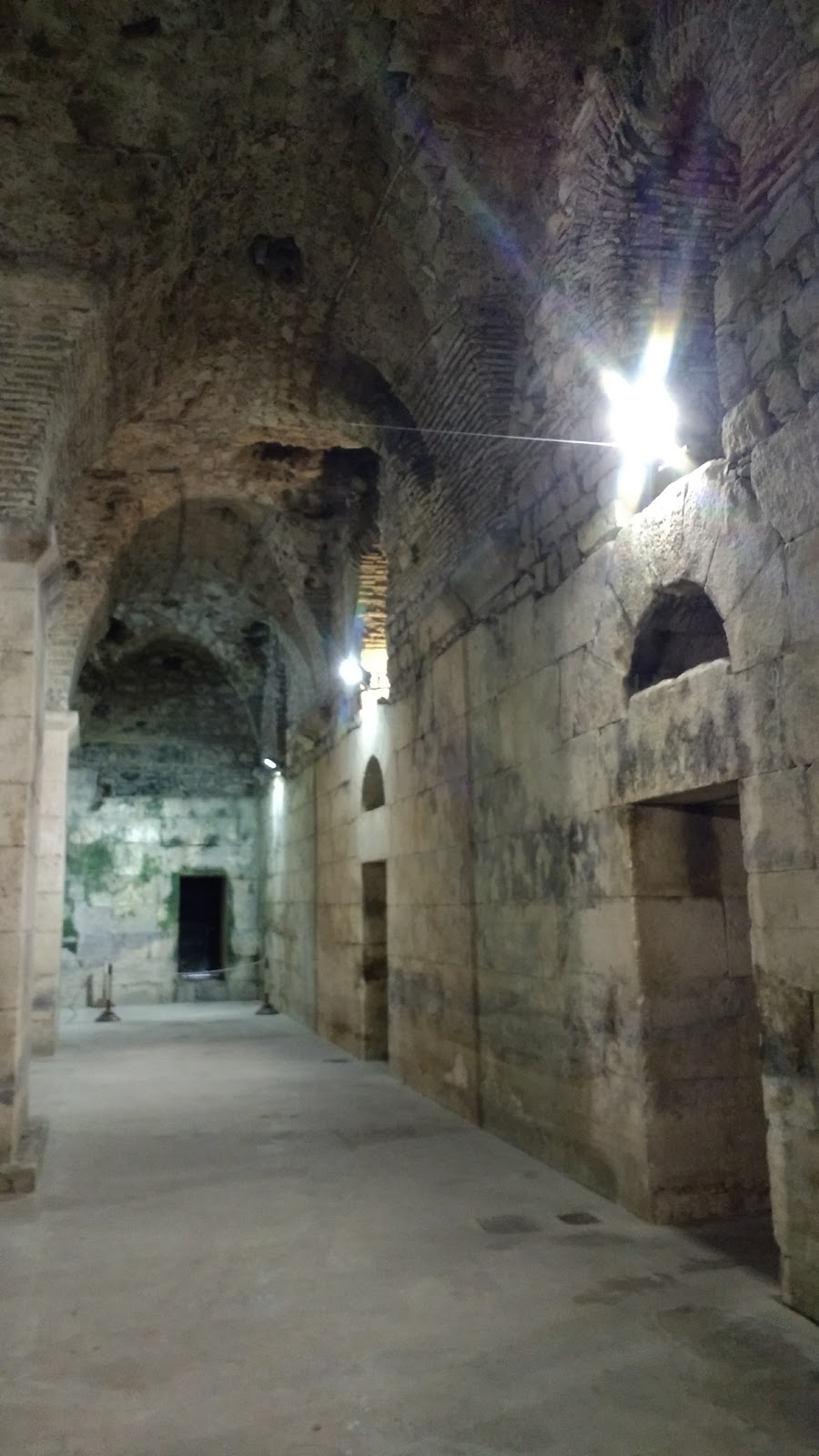
The subterranean portion is all that remains of this palace dating back to the Roman Emperor Palatine. It's also where Daenerys keeps her dragons.


View from tower in Split
One neat memory from Croatia is the bus rides along the Adriatic coast, from Split to Dubrovnik. I was eating dinner on the bus when an older man who was returning to his small village after visiting the market, and who spoke hardly any English, reached across the aisle to offer me two of his oranges. He smiled, and his eyes were so kind that I couldn’t say no. A few moments later, in return, I offered him a few of my roasted caramelized almonds. It was such a sweet little exchange! Another interesting thing about the bus ride between Split and Dubrovnik was passing through a small stretch of Bosnian coast and experiencing the strongest border controls of my entire trip. At each check point, both entering and leaving Bosnia, an immigration officer came onto the bus and examined every person’s passport. This was really strange after being in the rest of the European Union, where you can cross borders practically uninspected.


Snapped en route


Bosnia:


I went in with no expectations in one way or the other for Bosnia, and it was actually probably my favorite country of the trip (if there is such a thing as favorites). I had decided to go to Sarajevo because I remembered that in elementary school I read about kids my age who had survived the ethnic cleansing and war there at the beginning of the 90’s. It really impacted me back then, and I wanted to see in person what the country is like today, particularly the capital of Sarajevo. On the advice of Kieryn’s Bosnian friend, I decided to visit the small town of Mostar on the way. We don’t hear much about the Balkan states, but let me tell you, they are stunning!


Another bus window photo
Getting into Mostar was one of the most difficult moments of my trip. To begin with, the bus out of Dubrovnik was a few hours delayed (of course). A few travelers from Mexico and I small talked while we waited, giving me a chance to dust off my Spanish. Not only did the bus leave late, but also it lagged at each and every stop in intermediate towns. During one of these pauses, I was completely absorbed in my phone, playing my favorite game of "Let's see if this bus stop or a neighboring business has free Wi-Fi, and if my phone will connect to it!" when one of my Mexican friends smacked my leg. I whipped up my head . "You're going to Mostar, right?" I nodded. "You have to get off here. Now! Quickly!" We weren't there yet. I looked baffled, and they reiterated that something had happened with the bus, they didn't know what, but we needed to switch buses. There had been an announcement as we pulled into the station, but it was only given in Bosnian and in Croatian. Guess it was an important announcement. I thanked them profusely, and also sent a little thank-you prayer that we had chatted earlier and that they had remembered where I was going and taken the time to tell me, or else I would have ended up in the middle of nowhere.

When we pulled into Mostar, it was pitch black, pouring rain, and sometime after 10 p.m. It turned out there were multiple stops in town before arriving at the main bus terminal, and my lucky bet to stay on the bus until the end of the route paid off. I pulled up my HostelWorld confirmation email, especially excited for that night's lodging. I had booked myself an entire apartment for the evening, and it was still cheaper than a hostel in most major Western European cities. (Yeah, the US Dollar goes far in Eastern Europe). The host had sent me a map and walking directions, but I had forgotten to download the map. Oh well, I'd figure it out. Then it dawned on me - I had also forgotten to exchange currencies before I left Croatia. I didn't feel supremely comfortable using an ATM this late at night, especially with my large pack advertising that I was a tourist. Without cash, there was no way I could pay a taxi. So I started walking.

Mostar is a small town, but not as small as I'd hoped. The walking directions my host had emailed me were along the lines of, "Walk across the bridge, go a few blocks, turn right." After I had been walking 20 minutes in the pouring rain, I realized that I didn't have a clue where I was. I found a deli, one of the few businesses open this late, and asked them where I would go to catch a taxi. They said that I couldn't flag a taxi in this part of town, meaning that they would have to call one for me. I inquired if I could pay for the taxi in Euros. They shook their heads. Trying to conceal my rising panic, I said, "Ok, I'll figure it out," and left. I went to stand under the street light and flipped through confirmation emails on my phone, deciding what I could do. A moment later, one of the women who was in the deli came up and tapped my shoulder. "Do you need help?" I nodded, trying not to immediately begin sobbing. First she tried to call the phone number of my hostel, but it was out of service. Then she called a taxi and gave me a few coins to cover the cost. I tried to offer here Euro coins for the amount of the taxi ride, which she refused. I shot up another prayer, thankful for the kindness and mercy of total strangers. Then I waited near the side of the road, getting splashed with puddle water and skewered with bewildered glances from each passing car.

Finally my taxi arrived. My taxi driver, who was about my age, asked where I was going. I showed him the address. He looked back at my quizzically, and asked where I had booked my hostel. I replied that I had booked it online. He asked more pressing questions. I insisted that it was a legit place, with good reviews. He said, "I know that road, but I do not know of that number on that road. The numbers end much lower than that." He called two or three different people to ask if they had heard of that address, and none of them had. At this point I was ready to throw my hands up and just have him take me to another hostel, or a hotel. He read the email again, and then exclaimed, "Wait! Teo! I know that guy! I played soccer with him," referring to the apartment owner. Relieved, I ask, "Oh great! Do you know where he lives?" "Nope." We agreed to just drive to that road, and drive around until we found the house number. He parked on a corner, and pointed to a building, saying that it must be one of those doors. I got out, and rang the bell of the first door I found. It wasn't that one, but the neighbor pointed to the next door down. I rang again, and this time the apartment owner's mother answered. She was worried to death - she had been waiting for me all night. I was too tired to even begin to explain the whole ordeal. I tried to look apologetic and thankful at the same time. I then went upstairs, took a long, hot shower, and collapsed into bed.

Difficulties in arriving aside, I truly enjoyed the following day in Mostar. That afternoon, I took a bus to Sarajevo, and I'm pretty sure my mouth was hanging open the entire way as I drank in the fall colors of the Balkans. I was so sad to be missing the leaves' changing back in Colorado - little did I know that I would get to experience it so vibrantly in Europe!


Mostar

Stari Most, a famous bridge in Mostar. The original was destroyed during the war, so this is the second edition. Look carefully - you'll see the guy in white shorts, who would have jumped off had enough tourists paid him to do so. It's a tradition.
My mouth hung open for different reasons as we pulled into the bus stop in Sarajevo. My brain screamed, "Holy shit, are those bullet holes?" An abandoned building was so riddled with them that they appeared to be a part of the architecture, as if the designers had selected aerated siding. I had come to see what aftermath remained of the war, and clearly there was still quite a bit. There were a handful of bombed-out buildings in Mostar, but for some reason the bullet holes seemed so much more... personal.

Oh, Sarajevo. I feel in love with the city instantly. People get excited about Denver's mountain views, but Sarajevo is completely surrounded by mountains on all sides, and they are much closer to the city itself. Sarajevo also felt a little bit like Santiago, Chile, but with a distinctly Eastern European twist. It's hard to put into words what all I love about the city, because it's more the general feel you get being in a place, but I will try.


1. Cultural co-existence - Known as "Jerusalem of Europe" because Catholics, Orthodox Christians, Muslims, and Jews have shared the city for hundreds of years. For the most part the coexistence has been peaceful, with the glaring exception of the Bosnian genocide in the 1990's. A brief history lesson, which I'll freely admit I had to research: As the Soviet Union dissolved, countries began declaring independence: Slovenia, Croatia, and then Bosnia-Herzegovina. Orthodox Bosnian Serbs envisioned forming a "Greater Serbia" by joining together Serbian territory throughout the region. The Serb minority began attacking Bosnia, and proceeded over several years to ethnically cleanse Bosniaks, or members of the Bosnian Muslim majority, as well as Bosnian and Croatian Catholics. Sarajevo was under siege for four years, and the fighting was widespread throughout the region.


When I took a walking tour of the city, my tour guide espoused the importance of tolerance today in Bosnia. He said that given such a bitter, recent conflict, respect for the Other is very important today in Bosnia. However, most reports I've read say that there is still a long way to go in terms of dissolving the resentment, fear, and lack of understanding between ethnic and religious groups in the region. I'd say both things are probably true to some extent. Being in the city is a unique experience. I never was outside at the right moment, but they say that at noon you can hear the muezzin and the cathedrals' bells at the same moment. You can stand on the dividing line between the Christian and Muslim districts, and as you look left and right see two extremely different styles of architecture, restaurants, and shops.


Walking pedestrians made the pano a bit funky, but it gives you the idea!
On a personal level, Bosnia profoundly impacted me spiritually. I felt on a soul level the importance of deeply appreciating other cultures and religions. For example, I was so touched by the story of a Muslim librarian who had hidden a very old and sacred Jewish manuscript from Hitler during WWII. Thanks to him, the text survives to this day. It inspired me to stand up for those who are different than me. Alternately, I witnessed the devastation that hatred can cause. 

I also got the chance to experience Islam in a way I hadn't before by visiting a mosque and interacting with Bosnian Muslims. I was struck by the beautiful simplicity of the space. Whereas many cathedrals are lavish and littered with ornate side chapels with large plaques broadcasting the person who funded each space, mosques are beautifully simple. Wealthy Muslims prefer to fund community spaces, such as public baths and schools, because they believe that so long as the spaces are in use, the legacy of the donor lives on. This emphasis on community touched me, and gave me new insight to my Muslim brothers and sisters who also trace their faith heritage back to Abraham.


Inside a mosque
2. Tangible History -


The exact spot where Franz Ferdinand was shot, kicking off WWI

The effects of the Bosnian war were palpable. I asked my walking tour guide what he remembered of the war, since he was in elementary school at the time. He responded that his mother wouldn't let him wear red. Thinking that maybe red was associated with one faction or another, I asked why red was forbidden. He responded that it made it easier for the snipers to see him, and shoot at him. He said that once a sniper's shot passed within half a meter of him, and then quipped that the sniper must not have been any good since he missed. What do you even say in response to that?

Throughout the city there are Sarajevo Roses, or marks on the sidewalk that look vaguely like flower petals. They were formed by shell shrapnel, and the city paints them red as a reminder.


One of the more popular markets in the city is now roofed, because one of the largest massacres happened when a shell was shot into the market on a weekday.


The trees in the city are small and young, because they had to be replanted after the war - the citizens had to use whatever they could as fuel sources when the city was under siege.


Emily and I went to the Tunnel of Hope museum. The Bosnians actually dug a tunnel under the airport runway, since there was no other way to get food, supplies, or injured people in or out of the city for four years. A small section of the tunnel remains open, and you can walk through it. There is also a museum showing what life was like during the war. It was one of the most emotionally impactful places I've ever been.


On a less serious note, you can also visit the sites from the 1984 Winter Olympics. My friend Emily and I took a taxi up to the bobsled track, walked all the way through it, and hiked back into town. The bobsled track is haunting and enchanting at the same time. It, too, was touched by the war - the attacking Serb forces shot into Sarajevo from up in the hills by the track, so the track itself does have what appear to be bullet holes in it. Nowadays, the track functions as a graffiti gallery and place to party, as evidenced by the empty bottles we found in and near it. On the hike back down, we also explored some abandoned/destroyed houses that had fantastic views of the city and fall colors.


Bullet holes in the exterior foam insulation? Probably.


3. Food - Perhaps the best food of the trip. This is where the Turkish influence really shines! My favorite was ćevapčići, or sausage-shaped minced meat that came with a delicious tomato-based dipping sauce. There was also roasted meat and potatoes cooked under a huge iron plate, surrounded by hot coals. I ate all flavors of Turkish Delight, which is a gummy confection. The drinks were mostly delicious as well! One was a perfectly tart yogurt milk drink. The most unique, and unbelievably delicious, was Sarajevan Salep. It's a combination of steamed milk, powdered wild orchid bulb, cinnamon, and honey. It's impossible to describe the taste accurately, but it was sweet, comforting, and perhaps mildly floral. If I could make it at home, I'd drink it all the time! The one thing I didn't like was Bosnian coffee. They use coffee beans which are so finely ground that they have the consistency of dust, and they boil the grounds directly into the water with no filtration process. You alternate drinking little sips of Bosnian coffee with little sips of syrupy-sweet orange water. In my opinion, the former tasted like licking dirt, and the latter practically gave you a headache it was so sweet.


That meat cooking device
Salep


Bosnian coffee, orange water, and rose flavored Turkish Delight
4. Beauty - Photos speak for themselves


Overlooking Sarajevo

PC: Emily
5. People - I so enjoyed everyone I met in Bosnia. Of course there was my friend Emily from the hostel, who was a fellow American. She and I clicked pretty much right away, and I so enjoyed getting to know her. She just so happened to celebrate her birthday while in Sarajevo, and one of my favorite memories from the trip was our little celebration for her in the hostel. She went inside to chat with her family, and the Bosnians in our group insisted that "We must hide and surprise her, just like they do in the movies! She must be surprised!" So they taught us foreigners how to sing Happy Birthday in Bosnian, and we did, in fact, hide under the table and jump out and start singing to her when she came back out.

I really love Bosnians, and Eastern European people in general. They have a sharp sense of humor, and zero tolerance for nonsense and bullshit. At the same time, they are incredibly kind and open-hearted. You get the sense that they have lived through a lot, because they are fierce, and they are fierce in how they love as well. They are also ingenuous, because they've had to be to survive. One funny moment was when Emily and I tried to catch a taxi from the Tunnel of Hope museum, me to the airport, her to the closest transit station. In Bosnia, and Eastern Europe in general, people speak very little English. So we indicated to a shop owner that we needed a taxi, and he nodded. He made a phone call, but instead of a taxi company, he called a neighbor! The neighbor pulled up, and we used the calculator on our phone to communicate and negotiate a price for him to take us both to our destinations. When I got out at the airport, my mind froze in panic for half a second as I realized Emily would have to continue alone to her destination alone in the car with this stranger. We said goodbye and made eye contact, seriously agreeing to message each other to let the other know we had arrived safely to our next destinations.

I also loved the absence of one type of person in Bosnia - the Tourist. Now, Bosnia is trying hard to establish its tourism industry, so I do encourage anyone and everyone to go there! But, it was so nice to be in a place unmarred by the trashy style of tourism that favors tasteless souvenir shops over cultural interaction and experience. In fact, in one shop, a woman asked Emily and I where we were from. We responded that we were Americans, and she blurted, "Why are you here?" She was not unkind, but rather genuinely curious as to why we were so very far from home. The Bosnians we met in the hostel asked us all kinds of questions about America. Was it like the movies? What was high school like - Mean Girls? American Pie? Emily is from Texas, and actually got them to believe that we were all cowboys, and that we rode horses to school. Eventually they found out she was lying, but it really was interesting to be a cultural ambassador to a group of people who were deeply curious about our country. 

That's all for this post. Up next: Romania, Hungary, Czech Republic, Poland!


Thursday, November 17, 2016

On Traveling

A lot of people I know or meet seem fascinated by my decision to solo backpack for three months, and have a lot of questions about my experience. I decided to write a blog post about what the day-in, day-out life of a solo, female, long-term backpacker (who is also gluten free).


On Backpacking and Long-Term Travel:
Backpacking is a very different experience than vacationing. It’s a lifestyle. In other words, travel is my day-in, day-out existence for this season of life, and like any season of life, that includes benefits but also downsides.


I typically stay in hostels, sharing a room with anywhere from three to fifteen other people. It’s like a college dorm experience, but more crowded and transitory. Unless I’m in a city with cheap food, I try to only eat out once a day, and even then I often have street food or eat at a cafe rather than a nicer sit-down restaurant. That means I have to go grocery shopping in virtually every city I’m in, much as anyone would at home. I assemble the rest of my meals in crowded, sometimes poorly-equipped hostel kitchens, so simple meals are best. A few times on this trip, I’ve splurged on a cheap hotel room or a B&B, usually because I was hiking and there aren’t hostels in smaller towns. Having a room all to myself for the night is an enormous luxury!


As far as clothes go, I started with five shirts, two pairs of jeans, two dresses, two light cardigans for daily wear, and four outfits for working out (two for hot weather, two for cold weather). This means that I wear the exact same clothes in rotation. Since the weather has gotten colder, I got two sweaters and a winter coat at a second-hand store. I usually try to make it about ten days before I do laundry (because I have ten pairs of underwear). I have laundry soap, a sink stopper, and a clothesline with me, and I’ve done my fair share of sink laundry, both to stretch longer between loads of laundry and because I prefer to hand-wash some items. Doing sink laundry is better when you have bottom bunk, because then you can string the line up on the edge of your bed and make a curtain out of your wet clothes. Top bunk is more complicated, because you don’t want your laundry dripping all over your bottom neighbor. Most hostels offer a laundry service where they will wash and dry your clothes for 5 to 8 Euro, so when I commit and wash a full load of laundry, this is typically what I do so that I don’t waste half a day. Regardless of how laundry gets done, I have to strategically plan when to do it, and what to wear while I’m doing laundry so that high-priority items get clean. Afterwards, when I get my clean clothes back, I am always overjoyed at how good they smell!


One of the things people are most curious about is how I approach trip logistics. Before leaving, I had the first month planned (meaning I had hostels and transportation booked). I was hiking the first two weeks of the trip, and it’s takes more foresight to figure out how and where to get on and off the trail. The next two weeks I was traveling with my friend Ciera, so we had a rough sketch of an itinerary before she came so that we could make the most of her time. From there, I went to go visit my good friend Kieryn who lives in Vienna for a week. She helped me create a framework for my remaining two months, creating a tentative itinerary based on the list of cities I still wanted to see. Now, I am mostly sticking to this calendar. I try to reserve hostels or transit anywhere from a few days to a week ahead of time. I rarely know what I want to do once I actually arrive in an area. I ask the hostel staff for suggestions, chat with fellow travelers, and look at top-rated activities on Trip Advisor and Lonely Planet. Certain activities do have to be pre-booked because they are more popular - for example, entry to the Anne Frank House or Vatican City. For the most part, though, I show up with a flexible mindset and enjoy what each place has to offer!


Another question I get is how I move around. I consider a variety of factors, and usually end up choosing a relatively inexpensive option that isn’t grossly inconvenient. Within a region, this is often a train or a bus. I didn’t buy a Eurail pass, because it’s actually cheaper to buy tickets individually in most cases. Moving between regions, I typically find a cheap flight. I’ve also taken a few night trains, which are great because you still have a bed, you don’t lose a day to travel, and you save accommodation expenses for one night. Transit is surprisingly one of the more expensive elements of traveling, because I am moving so frequently, and lots of little tickets add up over time.


Travel days are great fun for two reasons. The first is getting to schlep around all my stuff! One gets a few stares from strangers when wearing two backpacks at once - a huge one behind, and a smaller day pack in front. My big pack weighs between 15 and 17 kilos (33 to 38 pounds), depending on how many clothes and toiletries I have at that time. I actually have named this pack - he’s called Sebastian, or Bastian for short, thank you very much - because he is my one true companion on this journey!


A backpacker in her natrual habitat
The other fun thing about travel days is not knowing where I’m going! After getting oriented in a city, it’s much easier to get around, but getting into a city and having no idea where you’re headed can be exasperating, particularly if it’s dark, late, or the weather is bad. Free hostel paper maps help, as do downloaded Google maps which I can use offline with my smart phone’s GPS (I finally figured out how to do this part-way through this trip, and OMG what a lifesaver!).


As you might imagine, the backpacker’s life can feel very unstructured, particularly for a Type A personality like me. I try to add some elements of routine. One is routinely unpacking and repacking my backpack in an effort to keep track of my things. I’ve still lost or accidentally left plenty of things, because I’m me, and I’m not always as careful as I should be. Organizing the pack is also strangely soothing, because my pack is one thing I have control over when everything else feels like chaos. Another important ritual is working out. I run about three times a week, and find it a great and unique way to explore new places. The goal was to do basic strength training once a week, mainly consisting of core work and push-ups, but it’s hard to motivate myself to work out on a cement or tile hostel floor with other people around. Another thing I do to appease my achievement-oriented side is giving myself “tasks,” which usually involve blogging about my experiences and logistical planning. I also still have to take care of certain tasks for the life I’ll return to when I go home.


Now that I have been gone for two months, I usually feel that I have really settled into a rhythm. I have a strategy for structuring my days and getting from Point A to Point B. Although stressful situations can and do come up, I am getting better at handling them because I have been battle tested at this point. And yet, there are moments in which I feel totally unmoored. Homesickness is interesting emotion for me. Some days, I am overwhelmingly excited to be where I am, and I spontaneously break into a grin in public places because I can’t believe that this is my life, that I get to do these things and see these places! Other days, I feel a vague nostalgia for home, but home seems to me an abstract concept. I’ve been doing this for so long that my life before almost feels like the distant past. Sometimes I panic at the thought of going home, back to a country run by Trump and to a job where I’ll jump into busy season working 70 hour weeks. And yes, I have my moments where I am overwhelmed by the longing to see my friends and family, to be in my own bed, to have my own space, and to know where I am and how to communicate for once. I am a person who has an extraordinarily difficult time being present in the moment, particularly when I am uncomfortable or have ample free time (hello, travel days). Therefore, I end up spending way too much time thinking about how my life was, or how it will be. All throughout the trip, I’ve been forcing myself to focus on the present, and to choose gratitude for that which I am experiencing in this very moment. It’s been my spiritual practice of the trip. I fully realize that months and years from now, I will want to give anything to come back to these months, and to this amazing experience.


On Solo Travel:


Solo travel is a blessing and a curse. It’s great in many ways, because I can structure the trip exactly how I want to. I choose where I’d like to go, what I’d like to do, and how long I stay. I don’t have to worry about anyone else’s mood affecting mine, or vice versa. I have so much time to think. I also have gained some distance from my life back home, which allows me to reflect on my choices, relationships, past, goals, dreams, and direction with a fresh perspective. This is especially important for me as a person who can be strongly influenced by the thoughts and feelings of people around me, without ever giving myself space to think about how I personally think or feel about an issue.


At the same time, solo travel is difficult and exhausting. I am the only person looking out for myself. I message my parents once every few days to let them know that I’m okay, and to tell them I’ve made it to the next place safely. However, realistically, no one except me knows where I am at any given moment. If something were to happen to me, it could be a really long time before any of my loved ones would find out. One thing my fellow travellers and I talk about is how little we matter outside of context. There is nothing like being in a foreign country, where you don’t know anyone and likely don’t speak the language, to make you realize how insignificant you are. No one is going to worry about what happens to you. That said, I’ve been overwhelmed by (and sometimes dependent on) the kindness of strangers who are willing to help me find my way.


Not having a travel companion can lead to somewhat humorous inconveniences, such as using the bathroom at train or bus stations (which, of course, are never free). It goes something like this: I dig a coin out of my wallet while wearing two backpacks, slide the coin into the slot and awkwardly push through the turnstile, finagle my way into the bathroom stall, and simultaneously slide off the huge pack and turn 180 degrees so I can actually use the toilet. If I had another person with me, they could watch my stuff for me while I used the restroom, and then we could switch.


Mishaps that would be mildly annoying or even humorous when with a companion can become overwhelming when alone. I am such an external processor! It helps so much to problem solve with someone:
“Hey, do you remember how to get back to the hostel?”
“Where do you think we go to catch the bus?”
“Oh crap, this security line is really long. Do you think we should start trying to get around people so we don’t miss our flight?”
But when I’m alone, these thoughts just ping around my brain and cause a frenzy. It’s hard to stay calm sometimes.


However, once I do resolve the problem and come out on the other side, it is the most empowering thing to realize that I could do it all along! The more times I successfully navigate difficult situations alone, the more confidence I have in my ability to handle anything that comes my way.  


Another complicated aspect of solo travel is your social life, and the absence of close friends. I am experiencing so many amazing things, and yet I don’t always have someone to tell, or to process with. Everyone back home doesn’t want to hear every detail of my life here, and I don’t blame them. Plus, they can never truly understand what I am seeing and experiencing because they are not here with me. The desire for companionship with people with whom I can share these experiences is a good motivating factor for meeting other travelers! I have met the most amazing people from all over the world, and we have so much in common because we are all travelling. At the same time, each person I meet contributes a unique perspective from their own culture and place, so I get to learn about how others view the world, too. Travel conversations can get mundane because it’s often the same conversation topics - where you’re from, how long you’re traveling, where you’ve been, where you still have to go, etc. I love the novelty of meeting new people, but also crave the presence of people who know me, people who can be comfortable being quiet around me, people who know my story. As a solo traveller, it’s a bizarre experience of constantly being surrounded by strangers, so you’re never truly alone, and never with your loved ones, either. And yet, your fellow travelers are in the same boat, and it’s amazing how deeply you can connect with people whom you just met. Every time I leave a hostel, I leave behind a few new friends. It’s a revolving door of hellos and goodbyes.


One other issue with solo traveling is that in many places, I am breaking cultural norms, particularly because I am a female solo traveler. There’s nothing quite like walking alone into a sit-down restaurant, surrounded by couples and families, and asking for a table for one. I’ve learned to bring a book with me everywhere I go, so that I can pass the awkard moments before my food arrives reading. I also repeat to myself a few times an excellent phrase which I saw somewhere once: Well, at least I enjoy my own exquisite company!


Overall, I am learning so much more about myself and others from traveling alone, and I wouldn’t trade this experience for the world!


On Traveling as a Woman:
Solo travel in and of itself freaks people out, but the fact that I’m doing so as a woman really is mind-boggling to many people. Yes, being a woman in this world is dangerous, but it’s dangerous no matter where I am. The illusion is that I’m safe at home. Just look at the statistics regarding sexual assault - I received numerous emails when I was a student as DU detailing the attacks that happened to other women at my school, in my neighborhood. However, I can admit that being in an unfamiliar place makes me more vulnerable than I would be in an area I know well. Knowing that I am alone and female makes me more cautious, at least compared to the male solo travelers I meet. I feel less free to do many activities - for example, I try not to be out alone late at night, and I am very careful how much I drink when I am out. I won’t go to clubs or bars unless I’m in a group. I am more likely to pay for a taxi than take public transit late at night.


Travelling as a woman only makes the sexism and misogyny that all women, everywhere, experience on a daily basis more salient. Here are a few stories of things that have happened to me or to friends on the trip so far which show what I mean. I already blogged extensively about Ciera’s and my experience as women in Morocco, so I’ll put the other stories here.


Barcelona, Spain - A large group from our hostel goes out together. A creepy man who is staying in our room starts dancing with Ciera, and then forcefully kissing her, even though she has already told him multiple times that she is not interested. Of course, there is more than a minor language barrier - he speaks very little English, but good Spanish and Portuguese, and Ciera speaks conversational Italian but neither of his other languages. I grab her arm through the crowd and ask her if she is okay. She nods, not wanting to ruin the rest of my night by asking me to leave. After it keeps happening, though, I realize that we all need to get out of there. When we leave with another friend from the hostel, the creeper comes with the three of us! When we get back to the hostel, the creeper actually crawls into Ciera’s top bunk! I motion to him to get down and repeat multiple times, in Spanish, that she isn’t interested, and that if he touches her again, I swear, I will kill him! This doesn’t stop him from trying to climb back up in her bunk a few more times, for good measure.


Lisbon, Portugal - One morning, Ciera goes down to the nearby square to get a cup of coffee while I finish getting ready in the hostel. It is a holiday in Portugal, so the whole city was out partying all night, and people are still drunk on the streets as they scavenge up breakfast. Ciera is at a table sipping her coffee when a beyond-drunk man approaches her and begins talking to her. She clearly isn’t interested in talking to him, and he notices. He asks, “Oh, do I make you uncomfortable? Why are you drinking your coffee so fast?” He keeps re-starting his stories, because he is angry that she isn’t paying enough attention. She chugs her coffee so she can leave.


Vienna, Austria - Kieryn and I are riding on the subway one night when two belligerently drunk men get in the car, carrying tall cans of beer. They sit down, stare at us, and immediately try to get our attention. They hoot, they holler, and then (such charmers they are), they start shouting, “COOKIE! COOKIE! Pay attention to us, cookie!” We can’t even focus on our conversation, but we sure as hell can’t look at them, so we try to keep our heads down. Then, they start yelling references to Hitler and saying that they are Neo-Nazis. First of all, one does not make references to Hitler or Nazism in this way in Europe - it’s shockingly offensive. Second, there is a strong right-wing movement in Austria right now, so they likely are Neo-Nazis.The whole thing really shakes us up. I even feel unsafe exiting the subway, because I am worried they will follow us.


Amsterdam, The Netherlands - I am walking to put my bag in storage as I arrive at the hostel when I notice a fellow guest staring at me. I think he might be trying to get my attention, but I ignore him. Later, I sit down at the table to take care of a few things, minding my own business. He is sitting further down along the table, and he starts talkin to me. As soon as words leave his mouth, I can tell he is high, drunk, or both. “Hey! You are so beautiful! I love your eyes! I love your earrings! So beautiful!” I roll my eyes, say “Oh gee, thanks,” in a clearly sarcastic tone, and reach for my headphones so I can ignore him. A few minutes later, when everyone else has left the room, he comes up and actually tries to kiss me! I forcefully shove his face away and tell him to leave me alone.


These experiences, combined with my experiences in Morocco, have taught me that I need to have a spine. Our whole lives, we as women are taught to appease, to be likeable, not to offend. I am worse than many women when it comes to wanting to be nice, and not to make others uncomfortable. Being on this trip has taught me that I need to learn how to politely but firmly tell men to leave me alone!


I am learning how to advocate for myself when there isn’t anyone else to stick up for me, and this is a skill I will use the rest of my life in all kinds of situations. I don’t always do it perfectly, but I’m learning to do it! For example, in Morocco, I got into some heated discussions with taxi drivers over how much we’d pay them to take us somewhere. You see, in Morocco, prices are not established - you have to negotiate them before agreeing to a service. We didn’t necessarily know the going rates, but local Moroccans told us about how much we should expect to pay, and these taxi drivers were charging us multiple times that, just because we were foreign! The difference in nominal terms was small, but it’s the principle of the matter, that we shouldn’t be charged exorbitant prices just because we’re not from the area. In one particularly embarrassing instance, a taxi driver and I shouted and waved at each other, before he slammed his door shut and we walked away. Then, when no other taxis came along, we had to walk back and agree to pay him the higher price he was demanding. So the outcome wasn’t what I wanted, but at least I tried to stand up for myself. Sometimes I am successful, though. In Romania, when my taxi driver kept looking down at his phone map whilst driving over twisting mountain passes, I told him to put his phone down because it made me nervous. When he couldn’t find my hotel, I told him to pull over so I could ask for directions - and he did! This may not seem like a big deal, but for me as a woman who has learned to be agreeable my whole life, it was a big freaking accomplishment! Every single time I stand up for myself, it makes it easier to do it again.


On Traveling Gluten Free:


It’s been two years now since my doctor found after a blood test that there was a high likelihood that I was gluten intolerant, and that I probably have Celiac’s. We never did the confirmatory scope test where they sample your small intestine because it’s invasive, expensive, and leads to the same result: eliminate gluten, and see how you feel. So, I was already a young adult when my diet changed drastically. It was also after I studied abroad, so this is my first time doing a long-term trip whilst gluten free.


You know how Europe used to be called Christendom? I vote that we re-name it Bread-dom, because that is seriously what people live on here.


Before I left, I always said that I was just gluten intolerant. So many people told me that I might be able to eat the bread in Europe, “because it’s processed differently, and most people just have problems with how we cultivate our food in the US!” This may be true for some people, but it is not true for me. I had Swiss fondue, with bread, my first week of the trip, and my stomach bloated almost instantly. I now say that I probably have Celiac, although I am not as sensitive as some people I know. For example, if bread touches my food, or the kitchenware used to prepare it, I don’t immediately become ill. This is a huge blessing. Still, it’s hard to travel while gluten free. Most quick, cheap food options are bread based, as are many of the local culinary specialties of practically any European country. Whenever I walk by a particularly beautiful bakery, I tell myself, “Don’t want things you can’t have,” and then I keep walking.


So, what exactly do I eat? I joke that the gluten free traveler’s food pyramid includes the following major food groups:
  1. Cheese
  2. Ham and sausage
  3. Potatoes in their many varieties
  4. Grilled meat
  5. Chocolate bars and Haribo gummy bears
  6. Gelato
  7. Coffee with milk
  8. WINE
  9. Occasionally fruit
In all seriousness, this is often all that I can find on travel days. I can’t tell you how many times a meal has consisted of Snickers bars, Haribo gummy bears, and a block of cheese. When I actually stay in a place longer, I try to eat more healthfully. Larger grocery stores often offer at least one or two gluten free products, and of course I can still eat meals like scrambled eggs and salads.


One difficult aspect is trying to understand whether or not a product has gluten in it when you don’t speak the language. I now have a ritual of taking a screenshot of the translations of “wheat,” “flour,” “barley,” “rye,” “gluten,” etc., in every country I go to. Then, when ordering in a restaurant or trying to decipher nutrition labels, I at least have a chance of getting it right. Of course, there are still unexpected issues. For example, I bought some cough drops in Romania and didn’t think to check the label, because in the US all cough drops are gluten free. I felt really sick for days, and it took me so long to figure out why - the cough drops had f-ing barley malt in them!


Some European countries are much more allergen conscious than the US. For example, a few have laws mandating that all restaurants indicate on menus which items contain common allergens. Quite frankly, I’d be happy if we started doing this in the US! Other countries are much worse. In Barcelona, our hostel prepared a communal dinner, where everyone could eat so long as they threw some coins in the jar. Ciera and I prepared our own meal, and let me tell you, I got very sick of everyone asking why I wasn’t eating the pasta like everyone else. One guy even said, “You Americans and your dietary problems - they’re all just imaginary! You made it all up!” Sure, buddy, the gut-wrenching cramps, visible bloating, and less delicate reactions I have are totally made up. I’m just an attention whore. Totally.


Being gluten free does add an element of adventure and elation to travel, because you look so hard to find things you can eat, and then get really excited when you find something spectacular! When I find good gluten free alternatives, I do tend to go a little crazy, as I did here in Budapest when I stumbled across a gluten free bakery! 


I almost wept with happiness when a restaurant in Ibiza served excellent gluten free seafood pasta. And when I found real Italian food.
A dedicated gluten-free pizzeria in Napoli... Oh my heart
Gluten free pizza AND beer!
In the same way that most people seek out great European beers, I seek out great new ciders. I have gotten to try some really interesting ones!

Just today, a fellow gluten free traveler introduced me to an app called Find Me Gluten Free. It looks pretty great - it shows you nearby restaurants with gluten free options, as well as dedicated gluten free facilities. I haven't used it yet, but it looks promising!

At the end of the day, I really wish I could eat gluten because it would make my life so much simpler. However, I’m learning to be more creative and stand up for myself better because I have to work harder to advocate for and take care of my own health while I’m here.


In Conclusion:
Travel, in general, puts you outside of your comfort zone and forces you to adapt. It allows you to see the world from new angles, and exposes you to different people, places, and cultures. The other aspects I’ve discussed here - long term backpacking, solo travel, traveling as a woman, traveling while gluten free - only intensify and enhance many of the challenging and rewarding aspects of travel in general.