Saturday, April 9, 2016

Why I'm Burning the Letters I Wrote to my "Future Husband"

One day in sixth grade, I remember confessing to my mother that I was worried about something: I hadn't yet experienced my first crush. At an age where many of the other girls in my class were going boy crazy, no one had really caught my eye, not even a Disney channel star or pop singer. My mother reassured me that this was normal, and that I was really quite young. Much to my relief, a short time after I developed a crush on the middle school bad boy - handsome, smart (but he would never show it), rebellious, with floppy long hair and tight jeans. It was the mid-2000's, after all.

Around this same time, like many evangelical girls around the nation, I loved reading Brio magazine, Focus on the Family's publication for teenage girls. Along with advice on family, friends, God, and (very modest) fashion, there were, of course, articles on boys. Unlike mainstream teen girl mags, these articles were not about trying to figure out whether he liked you, or cute date ideas. Rather, they were articles exhorting sexual purity, and cautioning against the dangers of dating. The idea was that when you meet your future husband, all the waiting will have been worth it. A handful of speakers and writers suggested that teenage girls start praying for their husbands and writing him letters saying that they were "saving themselves" for him. They also encouraged developing a "checklist" of character qualities that we should see in a boy before dating him.

I took them up on that advice. I began praying for "my future husband" and writing him letters at the ripe age of twelve. Every year or so throughout my adolescence, on a particularly lonely or emotional night, I would sit down to write him a letter. They were sappy, full of sentimentality that I had finally found "the one," and saying that I just knew that he magically embodied every trait on my Future Husband Checklist. I expressed my hope that he, too, had been "waiting for me."

How was it that in one short year I had gone from not really caring about boys, to writing sappy letters to the one I thought I'd marry someday?

My evangelical, conservative surroundings continued to develop my ethos on romantic relationships. My parents took me out for the nicest dinner I had ever had when I turned thirteen and presented me with a purity ring as a sign of my commitment to stay sexually abstinent until marriage. (My mother now insists that she just wanted me to wait until I was older before deciding to sleep with someone, but if that was her intent, that was a strange way to go about it.) About once a year in church youth group, we would divide up into boys and girls for the night to talk about the "Christian" ideals for masculinity and femininity in a marriage context. Here, we girls were told that wives were to submit to their husbands, and that husbands were to be the spiritual leaders of the homes. I hated the idea, but tried to make myself believe it because I was told it was the "right" interpretation of the Bible.

Thus began my incredibly polarized, inconsistent perception of my identity as female as I progressed through high school and my first years of college. On the one hand, I had excellent family and mentors who told me that I was capable and encouraged me to shine. I played adventure sports, worked out hard, excelled in school, rose to leadership roles in almost every organization I participated in, had great friends of both genders, began planning a career in business, and planned church service projects in our community. No one told me that I was incapable of doing any of these things because of my gender. At the same time, I became increasingly upset that nothing was happening in my life, romantically speaking. Every time that I liked a boy and demonstrated some level of interest in him, I was rejected. Was I not pretty enough? Not feminine enough? Would I ever be desirable? What if no one ever wanted to marry me? My poor parents, and siblings, and friends heard me cry so many times. I was deeply discontent about my singleness.

As time went on, things got darker. By the summer before my junior year of college, I still had never had a boyfriend. My fears strengthened. If the man was supposed to be the leader of the home, what kind of man would be "strong enough" to lead me? Several people had actually asked me this question, point-blank. I became romantically interested in a friend, despite the fact that at times he was indifferent to my feelings and treated me poorly, because he was authoritative, military-type, and traditionally masculine. Once, he told me that I would "have to marry an MMA fighter to find someone manly enough for me." Another time, we were sparring verbally, and he said something so rude that I half-jokingly, half-seriously hit him. He hit me back. Hard. Everyone in the room froze - it was so clear that a line had been crossed. And yet, when I prayed about it, I felt so certain that he was "the One" for me because he was "manly enough." I even told a few people so. Thankfully, I went to go study abroad, and he started seeing someone else, so nothing materialized between us.

My actions soon turned inconsistent, too. I maintained that I was going to remain "pure" until marriage, but I would get drunk and make out/hook up with boys, both abroad and occasionally after I returned home. I began having very serious doubts and questions. What does the Bible really have to say about women? Do men have to be leaders in marriage? What role can women play in the church? What does the Bible really have to say about pre-marital sex? What about masturbation? How are women realistically supposed to engage with their sexuality when for many women there is a ten-to-fifteen-year age gap between when their hormones hit and when they are married? I felt guilty every time I "rebelled", but frustrated when I asked these questions or admitted that I was struggling. Some seemed shocked, uncomfortable, and incapable of handling any authentic questions about female sexuality. Others treated me with compassion (varying between patronizing and authentic), but shrugged and told me that the Bible said what it said, that this was God's plan, and that I just needed to pray harder and surrender more. In other words, figure it out. To this day, I believe that one of the main reasons that I was never asked to have a leadership position with the Christian group I was involved with in college (when all of my other friends were on the leadership team, and when my work as a leader was highly valued in every other organization I was a part of) is that I asked hard questions, and that me being a strong woman made them uneasy and me untrustworthy when it came to mentoring and shaping others.

Thankfully, God has enough grace for me to question, even when humans don't. A lot has changed since then - I've been dating a wonderful man for over a year, and he loves me because I am a strong, ambitious woman, not in spite of it. I do not make him feel emasculated, and our relationship is very much a partnership. I also have done extensive reading and research on femininity, from Christian and secular sources, and have come to my own conclusions - essentially, that women are equally valuable to men, powerful, and capable of creating an enormous impact. There are differences between men and women: some biological, many results of socialization. Ultimately, the heart of God is for all of us to work against patriarchy. Nowadays, I rarely fear that I am not feminine, or that I will die alone (although old fears do have a way of popping up every now and again).

Nonetheless, the hurt and the damage remain. The letters I wrote to my future husband are a tangible representation of the ways in which gender roles destroyed me. I am burning them to express the lingering emotional collateral.


I am angry that I was told at such a young, impressionable age that I should be waiting around for "my future husband." The message I received, over and over, is that I was not complete until I met "the One." It is absurd that anyone would encourage young teenage girls to think about marriage, when they likely will not wed for years or perhaps never at all. I am angry that I was made to feel that something was wrong with me because of my strengths and capabilities, purely because I was born female. I was told that (at least in certain aspects of my life) I needed to tone myself down so as to not injure the fragile male ego. I wonder at what I my life might have been like if I didn't waste so much emotional energy worrying about my future spouse and whether I would ever be enough as a woman. I've always been a perfectionist, and that is a separate issue, but I wonder if my perfectionism wouldn't have driven me so hard, wouldn't have broken me down so much, if I had a fuller sense of who I was as a woman. I wonder if I wouldn't have put on 25 pounds from emotional eating because I felt deeply inadequate but was too scared to sit with such an emotion, so I ate myself numb instead.

I am saddened by how the church has manipulated and controlled female sexuality throughout the centuries. In the Inquisition, male church leaders feared that women were temptresses under the employ of the devil to cause Christian men to stumble. Women were accused of witchcraft, tortured, and brutally murdered. I visited a museum in Mexico at a site were such atrocities occurred, and let me tell you, it is horrifying. Today, in the United States at least, the form of control may be more subtle and less severe, but it is control nonetheless. My friends attended a church which literally put out a cake, and took chunks out of the cake as a metaphor for every sexual encounter a girl had before marriage. They then frosted the cake with white frosting, saying that the "grace of God" could make you "clean" again, but that under the surface you would still be damaged goods. The psychological damage of such a vivid metaphor is harmful, not only to girls who had consensual sex, but also to the large percentage of girls who are sexually abused. Another winning method is imposing strict dress standards on girls, telling them that they should not "cause their brothers to stumble" with their clothing. In other words, your sexuality is dangerous, and therefore we must protect males from you by controlling you. And oh, by the way, your sexuality isn't actually yours anyway - it belongs to the magical mythical man whom you will someday marry.

I am devastated knowing that the same patriarchal lies I believed for so long are still running rampant in our world, and having very real effects on people. There are other strong, capable women in the North American evangelical church with stories very similar to mine, and I feel their pain. However, the damage we suffer is light compared to many other women. I shudder to think how many women in the church stay in abusive relationships because "male headship" can quickly dissolve into aggression, as I saw with a man whom I thought I wanted to be with. Outrageously, many widely-followed evangelical leaders speak out against divorce, even in the context of abuse. My heart breaks for women in other parts of the world who face considerably less freedoms and privilege, and considerably more danger, for being female than women in more egalitarian nations.

I am scared to admit what I felt for so many years. Reading this with some level of detachment, I acknowledge that many people hearing this would shame me for what I have written. The world tells us a lot of bullshit, and we have to choose to believe was is true. People could easily think, that's dumb, why would she believe those things? Or, if she was such a strong, independent woman, why did she latch on so quickly to what others told her? Get over it. Move on. I worry that I'll be labeled another entitled, overly-sensitive Millenial, who whines about the fact that the world has given her an unfair lot when in reality the world is just an unfair place. To which I say, it's real. It happened. It hurt. Everyone experiences hard things, and it's important to deal with them. If we don't deal with them, they become toxic, and we cannot change the pattern, making us very likely to inflict the same hurt on others.

I am also proud. I am proud that I was brave enough to question everything that I had been taught, and willing to consider a different way. I am proud that I continually get better at feeling my hurts rather than numbing them. I am proud that I have fought so hard to gain back my mental health and to build a healthier identity. I am proud that I choose to speak out about what I experienced, so that maybe another girl or woman feels less alone in her own hurt. I am proud that I want to work toward a better world, in which "female" does not mean "lesser."

Finally, I am unsure how to move forward. I don't know how to re-engage with a church which has made it clear that my type of woman (one who is unabashedly strong and doesn't buy the literal, historical interpretation of the Bible which is used to shame women) is not welcome. Even outside of the church, it is often exhausting being a woman in this world. I am privileged in so many other ways which help me to overcome (or not even have to face in the first place) the obstacles which face so many other women, but my heart breaks that such obstacles exist in the first place. I'm starting by burning these letters, as catharsis. However, ultimately holding onto my anger and resentment will only make me bitter and ineffective. I suppose I'll end this by saying that I'm praying that I can continue to heal, that other women will continue to heal, and that we as a church, we as a nation, and we as human beings continue to work against patriarchy and the shameful subordination of women.


Wednesday, August 19, 2015

Tax, Fiscal Policy, and Immigration Reform

Since I've seen some interesting posts lately about various political candidates' proposals regarding immigration reform (Donald Trump, I'm looking at you), it seemed relevant to share my thesis. I double majored in Accounting and Spanish, so it should make sense that I chose to write on the Tax and Fiscal Effects of Immigration Reform.

Should you choose to read it, please understand that this was the very last thing I squeezed in before graduation, so I didn't exactly have the time to make it perfect. Hopefully you will still find it thought-provoking.


The Tax and Fiscal Effects of Immigration Reform


The ultimate conclusion of the paper? Simply granting citizenship to currently present undocumented immigrants would cost the government more in benefit payments than the government would receive in increased taxes. This is because families headed by undocumented immigrants could begin receiving benefits for which they are currently ineligible. Nonetheless, the alternative of mass deportation and/or increased border control has proven to be very expensive and not effective, not to mention a human rights violation. However, making the immigration process easier for all would greatly benefit the US budget. Undocumented immigrants are only a smaller subgroup of immigrants as a whole, and immigrants actually earn more and need less government support than the average domestic-born American. Read the thesis if you want the evidence I used in arriving at this conclusion!


For those who don't want to read a 20 page paper, here are a few fascinating tidbits (see the paper itself for proper citation):

  • There are 4.4 million people waiting for visas to come to the US. Depending on visa category, the wait times are between 19 months and 33 years.
  • In 2010 alone, undocumented immigrants paid $13 Billion (yes, Billion with a B) into Social Security, a benefit which they are not eligible to receive. Each year about $9 Billion of that goes into a suspense fund, essentially an account for payments received which cannot be credited to any person in general. This money, of course, is available for paying out benefits to those currently receiving Social Security payments.
  • Naturalization in and of itself is estimated to increase an immigrant's earnings between 8 percent and 11 percent, with no change in human capital characteristics such as language abilities or industry-related skills. This translates into more income taxes paid and/or fewer government benefits needed.
  • Undocumented workers pay an estimated $12 Billion in state and local taxes each year. Their effective state and local tax rate is 8%. For comparison, the wealthiest 1% of the population has an effective state and local tax rate of 5.1%.
  • The US Border Patrol budget increased tenfold between 1993 and 2010. Meanwhile, the number of undocumented immigrants in the US has tripled. Other statistics which have increased include the number of border-crossing deaths (from 263 in 1993 to 463 in 2012) and non-criminal deportations (from 116,000 in 2001 to 240,000 in 2013). Over 108,000 of the people deported each year have children who are US citizens.
One final note: I welcome opposing viewpoints, so long as they are respectful. I do not tolerate remarks which are mean-spirited or which demonstrate ignorance toward an entire nationality of people.

Sunday, December 8, 2013

To the Ends of the Earth

Well, it's safe to say that our trip to Patagonia was the perfect climax to my time here in Chile. I have seen many, many beautiful places, especially since I live in Colorado, but I can safely say that Parque Nacional Torres del Paine is the most breathtaking place I have ever been. 

The beauty made all the effort invested in the trip well worth it! First of all, we had all of our final papers and projects due in the week and a half leading up to the trip, on top of lots of goodbye parties, so I went into the trip pretty worn out. Exhibit A: I submitted my last paper on December 1st at 2:30 am and woke up at 4:30 am to catch our taxi.


Second of all, anyone who knows me, knows that I like to plan... definitely too much. Anyone who has traveled in Latin America also knows that the culture here is much more live-in-the-moment, so it is essentially impossible to plan too far in advance because you will have to change your plans. I wish I could say that I had remained 100% calm, cool, and collected when we had to adjust plans (buying bus tickets down there because the companies overcharge if you use PayPal to buy tickets in advance, shortening the trek to 4 days instead of the original 5 I had planned, etc.), but that wouldn't be the truth. I am so thankful that Rachel, Emily, and Kari were there to talk some sense into me!


Finally, this was my very first backpacking trip, so I had no idea what to expect! I stressed out in Líder (Chilean Walmart) and leaned toward the side of buying too much rather than too little. Most of my purchase mistakes were easy enough to fix because I could simply leave food behind at the hostel, but one stood out among the rest. I asked a store clerk to show me where the jerky was. He did, and then asked if I cared what kind of meat I got, to which I replied that I just wanted the cheapest. Later on I discovered that the jerky I had bought smelled like dog food and had the texture of hay. Then it all clicked- "charquí de equino" definitely meant horse meat jerky. I managed to choke down about half of it, but eventually had to pass it on to a friend because it was probably the most disgusting thing I have ever eaten. I made myself the butt of many jokes. Example: (as we are trekking along) Kari- "Hey guys, I'm so hungry I could eat... wait for it... a horse!"


Now that I have adequately depicted myself as a basket case, I will begin talking about the trip itself! We flew into Punta Arenas, which is the southernmost continental city in the world; there are towns further south, but no more cities. Translation: we traveled (almost) to the end of the earth:


We then took a bus slightly north and spent the night in Puerto Natales, where I unknowingly ordered the biggest burger I've ever seen in my life- it was probably about 9 inches wide. I could barely finish half.


The next morning we got up early to take a bus into Parque Nacional Torres del Paine! We had decided to do the W circuit, named so because it is quite literally shaped like a W. It is a 4 day/3 night trek, although many people will stretch it out into 5 days/4 nights. You can hike it east-to-west, but we chose to hike it west-to-east. There is also a 9-day full circuit of the park, but we felt 4 days was much more manageable. Upon arrival to the park we took a catamaran boat across Lago Pehoé and got our first peek at the beautiful mountains we'd be hiking around all week:

Starting out!
On the other side of the lake we arrived at Refugio Grey. In addition to several free, basic camping spots, there are several refugios along the path, which are hotel/camping site combinations run by private companies. You can pay a ton to stay inside for the night, or you can pay a little bit for a campsite and use of bathroom facilities and a warm-up hut. As college students, we clearly went for the latter. You also have the option to rent camping gear and buy food, which is nice for people who want to do the trek but don't want to carry super heavy packs, or for people who run out of food or have problems with their gear. We discovered along the way that one of the sleeping bags we had rented in town had lost all its down filling, so it was great to have the option to rent better ones along the way! 


After setting up camp and switched to lighter daypacks for a 6+ hours out-and-back hike alongside Lago Grey (22 km/13.7 miles round trip). Kari and Rachel are riddle and logic-game masters, so we stretched our brains a bit to pass the time as we trod along. We got to see the tip of Glaciar Grey from a distance, as well as some chunks of ice that had broken off it:


As we were hiking, a storm came in. Before going to Patagonia, we heard a lot about a) the beauty and b) the unpredictably fierce weather, but we had fully underestimated both of these things. Patagonia felt no regret in spiting us for our ignorance. The winds were so strong that in places we could try our best to fall over and not succeed because the wind held us upright. 


Also, we had to jog in some places because it was too much effort to keep our feet planted while walking. What should have been a three hour hike back to camp ended up being just over two; the wind carried us forward with each step to the point that we were just about flying. 

As the hours passed by, the winds grew fiercer and the rain started to come down. The sun sets around 10 pm this time of year, so we had planned to arrive back in camp around 9 and have just enough time to cook before dark. We were therefore the last people to come in for the night. As we rounded the bend and came into camp, at this point soaking wet and freezing, every single person in the lodge could see us coming in through the oversized glass windows. There is nothing quite like receiving pity stares from 40+ people all at the same time, some of whom even came outside just to verify that yes, we were indeed miserably cold. We then went to check up on the tents, only to discover that Rachel's and mine was being blown almost completely flat to the ground and that Emily's and Kari's had flooded. After I let loose a few choice words, we moved our tent, tried to mop out the other girl's tent, ate a sullen dinner, and laid our clothes out to dry in the warming hut overnight while we went to sleep. It's safe to say this was a low point of the trip for everyone.

The next morning we got moving again. It was still windy, but the gusts were less fierce and it was only drizzling. We hiked 2.5 hours (5.5 km, 3.4 miles) on a rolling trail surrounded by scrubby hills to a rest spot. After a quick lunch, we dropped our packs and headed up through la Valle del Francés. This section had many types of beauty juxtaposed together. To the left we had a bare mountain covered by snow and glaciers:


To the right we had the stark tower-like mountains and rock formations:


And along the trail were some really nice waterfalls, most of which were clean enough to drink from without purification. It was the most delicious water I have ever tasted!


Unfortunately, the wind was still strong enough that day that we could only hike about 1 hour up through the covered part of the valley. Once we emerged from the tree- and hill-cover it was clear that it would be nearly impossible to continue, so we turned around and headed back to grab our packs (probably about 5.5 km/3.4 miles round trip). We then hiked another 2.5 hours to our next camping spot (5.5 km/3.4 miles, bringing the day's total to 16.5 km/10.2 miles). We passed through beautiful forests with some really funky fungus growing on the trees:


And directly along some Mediterranean-looking lakes with electric blue water and cool rock formations behind them:


Photo credit: Kari Ayoob
The next morning the sun finally came out, and boy was the view amazing! In this picture you can also see the ciruelillo, or the bright orange flowered bushes that absolutely cover the hillside during springtime in Patagonia. 


My mood was improving even more exponentially than the weather. Just as it always does, God's creation allowed me to let go of the stress of life and be present in His beauty, move my body, enjoy the companionship of some amazing friends, and let my mind wander. Our third day contained more uphill and steep sections than the other days as we approached the main attraction: the Torres del Paine. I actually get some perverse enjoyment out of hiking uphill- I can get into a better pace and the exertion clears my mind more. I think it's the cross country runner coming out in me.

The first part of the third day was passing through grasslands with view of the same mountains and lakes as the day before- During the second part of the day we turned into a valley and crisscrossed our way over rivers and streams. 


We hiked about 3.5 lazily-paced hours to our lunch spot. We had anticipated hiking a lot longer, but we were able to take a shortcut that everyone knows about but isn't on the map (thus mileage unknown). We ran into a ton of people we knew as we were hiking, not only this day, but really throughout the trip. Many of the other students at our university decided to take off right after finals as well, so we saw lots of them and some of their parents who had come to travel with them. We also ran into a few other DU students who are studying in Latin America, which was unexpected and really awesome! In addition to the friends we already had made, we met tons of new people from all around the world on the trail and in the camping spots. There is a special sort of bond that forms when everyone is trekking and experiencing nature together.

DU Reunion!
From our lunch spot we hiked about 1.5 hours more through the forest to our camping spot for the night (4.9 km, 3 miles). The views on the way in weren't too shabby:


Once reaching Campamento Torres, I decided to wander off in the woods alone, listen to my iPod for the first time in a few days, and just soak in the beauty. I found a rock field with this view and proceeded to a) sing along to some praise music and give God some cred for His amazing handiwork and b) jam out to some alternative music (Black Keys waddup!) while stretching out my tired muscles.


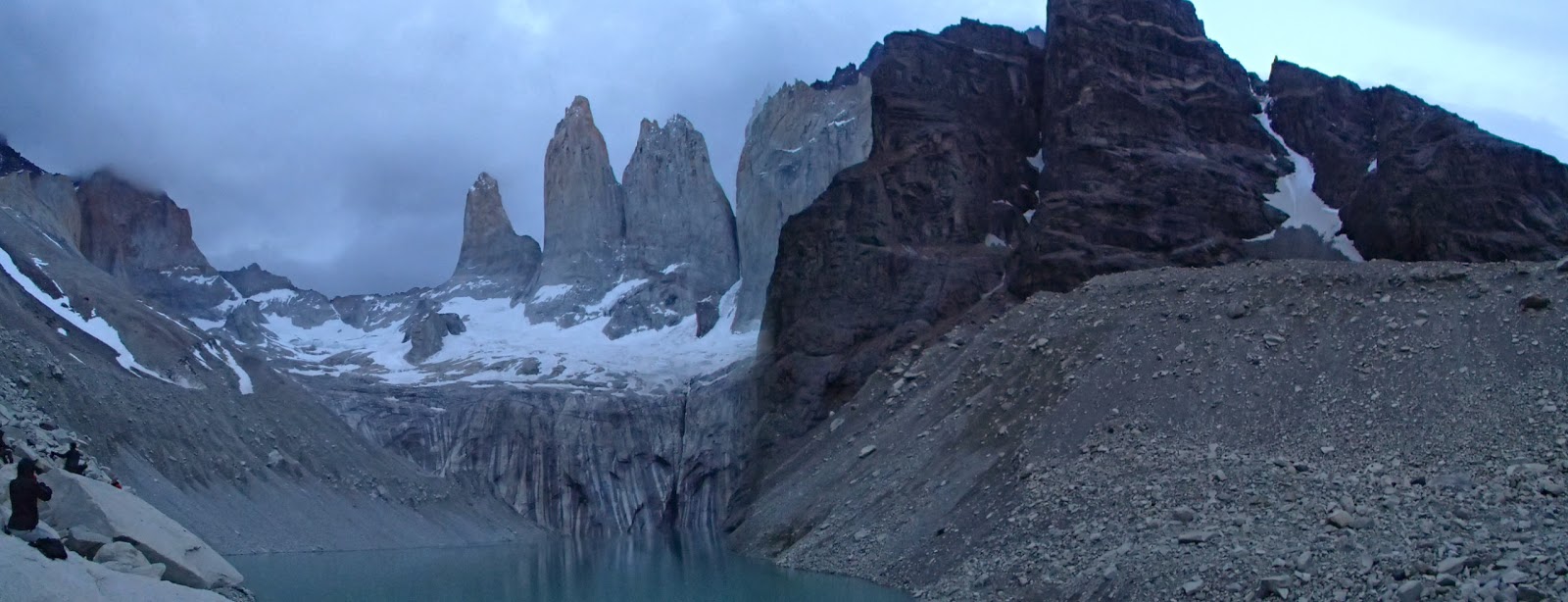
When I got back into camp, my friends had talked to the park ranger and determined that because it was a relatively low-clouds day we should hike up to see the Torres del Paine immediately rather than waiting until the morning. So we did. Something about my private jam sesh had given me a second wind and I flew up the 45 minute hike up steep hills and over rock fields in about 30 minutes. What I saw at the top will forever stand as one of the most amazing things I have ever seen. It quite literally stole the breath out of my lungs:

Emily in front of the Torres, to give you a bit of perspective on just how much they tower into the sky
I would have stayed forever if I could, but it was starting to get dark so eventually we had to head back down to camp. We were so high on life! We were laughing and joking around more than we had in a while, and one of our German friends whom we had met on the trail came up and asked "How do you all have so much energy? That's the first laughter I've heard in days! Or, at least, we're so exhausted that not much laughter is going on in our tent." It was cool to finally be the cheerful ones, especially because I had been so grumpy at points earlier in the trip (see: planning the trip and first night).

We went to bed and got up again around 4 with intentions of hiking up to the Torres again for sunrise. On clear days the rising sun shines upon the Torres and turns them bright red. Unfortunately we didn't get a clear day, but it was still amazing to snuggle up in a sleeping bag and spend a few more precious moments drinking in the view in the early morning light.


Eventually we made the hike back down, with trembling legs and soaring hearts, to pack up the tents and start our descent out of the park. Added bonus- the whole week I was thinking, Man, I would love to do some trail running here, and I finally got my opportunity on the last day. Why, you may ask? Well, because about 15-20 minutes outside of camp I felt a little internal nudge (thanks God) and asked my friends who happened to be carrying the camp stove that day. After a few "Not me"'s and some panicked stares, we realized that we had not only left it in camp, but that we had probably left it still burning with the little bit of hot water that we hadn't used that morning at breakfast. So I jogged on back to camp, confirmed that the stove was indeed still burning but that it hadn't exploded (whew), tried to fold it up while it was still flaming hot, and then jogged back. All's well that ends well, as they say. 

With that, we put our tired legs to the test to haul up a few final ascents and down many more steep declines, which if you've hiked before you know is actually harder than the uphill on your thighs. About 3.5 hours later we reached the finish: sweaty, smelly, exhausted, and triumphant!


Photo credit: Kari Ayoob's camera/our German friend
Not only did we survive trekking in Patagonia, we did it as a girls-only group! There are relatively few ladies who are willing to go without showers, do tough physical activity, and sleep in the cold for such a long time, and I couldn't have picked a better group to go with. So much love for these girls!

That afternoon we took a bus back to Puerto Natales. At dinner we each ate an entire pizza by ourselves and split a dessert pizza. I then proceed to sleep for over 14 hours. Let's just say that 4 days of intense physical activity changes a person.

Finally, since we had booked our plane tickets with the intention of spending 5 days trekking, we had an extra day to hang out and rest in Puerto Natales! After seeing statues of this weird horse-bear looking creature around town, we finally figured out that it is a mylodon, an extinct species of giant ground sloth. One was found perfectly preserved in a cave just outside of town, so it has become a mascot of sorts.

Photo credit: Kari Ayoob
We also walked along the shore for a little bit and did some Karate-Kid inspired picture taking.

Photo credit: Kari Ayoob
Finally, at the end of our last night in the hostel, the hostel owners sent us off in the Patagonian tradition of offering guests a drink. We got to try calafate liquor. The calafate is a type of berry native to the region, and they distill it into a very sweet liquor that tastes a little bit like blackberry. It was delicious!

Photo credit: Kari Ayoob's camera/Hostel owner
And with that, I will also say "Cheers/Salud" to this blog post! Now I am off to enjoy my final week here in Chile. 

Saturday, November 23, 2013

Things I Am Going to Miss, Part 1: My Internship

My time here in Chile is starting to wind to an end, and with that comes the beginning of the goodbyes. I am going to try to do a few blog posts about some of the things I am going to miss most here in Chile, and at the same time provide you all with a view of my more day-to-day experience over the past 4+ months. 

I'm going to start off with my internship. As I have mentioned in an earlier blog post, I was blessed enough to spend a few hours each week working with APARID, a long acronym for an even longer name that translates to Parents' and Friends' Group for the Rehabilitation and Integration of People with Down Syndrome. 

I spent a few hours every Monday evening with the Reading Workshop for 17 young adults (although "young" is relative- some of the participants are my parent's age). In some ways I was a true intern. For example, I would help them with the reading comprehension questions when they didn't understand; they were always really eager to show me their work and get my approval of it; and once in a while they called me "profe," short for professor. But in many ways we were more companions than anything. We sat side-by-side, we joked around, and we talked about their weekend activities, classes, families, and significant others. For the three who are working in the national Congress, I asked them about their jobs, and with the others I talked about their workshops in which they make and sell baked goods and greeting cards. 

I also was lucky enough to see them perform selected scenes from Jesus Christ: Superstar in the Viña del Mar Talent Show for People with Disabilities. Some sang along with the songs while others lip-synced, and they all danced and acted. They did an amazing job!


Receiving the award of participation afterwards
Here's a little bit more about a few of the friends I've made this semester. I would love to tell you about all of them, but I'll restrain myself.

Here in the top picture we've got Maximiliano and Georg, goofin off per usual. They are best buds, along with Felipe, who is in the lower of the two pictures. They are experts in the fist bump and the bro hug: clasp hands, pull together, a few pats on the back, accompanied by the Spanish version of What's up, dude?


This is Giovanna, who is probably the sweetest of the group. Every time she saw me for the first three months she would always say, "Michaela, right? (I nod) Hi! I'm Giovanna!" She especially took to the other volunteer, Pamela, a 60-something woman who is also from the US and who is in Viña with the Mormon church serving as a nurse for all the missionaries. Giovanna always called Pamela "regia" (fancy refined lady) or "joven" (young woman). 


This is Verónica. She is a firecracker! I love her personality, maybe cause she too is a strong determined young woman :)


Here are two of the couples of the group: first are Cristian and Dominique, and below are Constanza y Luis. They are so adorable- ok, sometimes a little too adorable, as they would start making out in class sometimes. I understand, though, because their families are fairly overprotective and they don't have a lot of opportunities to go on dates. They hope to get married and maybe even have kids some day.


I could go on and on, because I love them all, but I'll wrap up this part of the post with a group picture from one of my last days in class:


I also got to go to the Gardening Club on Wednesday afternoons. This group had a really fun dynamic because it was a mixture of kids with down syndrome and their siblings, plus Pamela, who is one of the women who runs APARID and also a mom of several of the kiddos, and Tanchy, the wonderful volunteer who runs the workshop every week. Part of the emphasis was on environmentalism, so our gardening project almost always involved transforming old soda bottles and other "trash" into planting containers for flowers. We also grew some vegetables and herbs in a garden. Basically, I got to play in the dirt for an hour every week with some exuberant little ones, which made me a very happy camper.


Probably my happiest moment in my internship was earning "tía" status. "Tío" and "tía" mean "uncle" and "aunt" but here in Chile are used as a general term for any adult for whom you feel affection.  For example, my host siblings call my mom's boyfriend tío (although I think they also still use "usted" with him, which is the more formal version of "you" as opposed to the less formal "tu"). Basically, señor and señora feel too formal, and the adult's first name feels too casual, so I love that they have a comfortable intermediate term. All this to say- at some point the kids started calling me "tía" and I was so happy I could cry!


So, since I am wrapping up my classes, this past week was my last with APARID. Both Monday and Wednesday the workshops ended early so we could have a small going-away party. They gave me some really sweet cards and going away presents, most of which they made themselves!


Two of the girls even sang a few songs in honor of Tanchy and I, one of which included sign language along with the lyrics. I think it's sufficient to say that I am going to miss them!

Saturday, November 16, 2013

On Top of the World

This weekend is a significant mile marker: I have now been in Chile 4 months, and I only have 1 month left. It has gone by really quickly, but at the same time it feels as though I have been here forever. The idea of being back on DU's campus, hanging out with my best friends, skiing with my family, or even being able to interact in public without having to speak Spanish seems strange, like a far removed part of my former life experiences. 

Knowing that I only have a month left is sharpening my vision; I am more determined to make every second count! That was definitely my intention when I stretched the 4-day weekend our university schedule gave us (October 31st-November 3rd) into a week-long vacation (October 28th-November 5th) with my good friend Rachel. What's a few missed days of classes here or there, right?

Our first destination was Pucón, a tourist town that reminds me of many of the mountain towns of Colorado. It's located in the lake region in the south of Chile and is considered the northernmost starting point of Chilean Patagonia. Rachel and I essentially spent the entire week outside, which was awesome! We got in Tuesday morning and then took an afternoon bus into Parque Nacional Huerquehue (pronounced wear-kay-way, in case you're curious). We didn't have as much time as we would have liked, but we still got to see a beautiful lake and a stunning waterfall:


We also got to glimpse Volcan Villarrica from a distance (more about this volcano to come):


and some excellent wildlife:


The next day we went white water rafting in Río Trancura:


Thursday ended up being cloudy and rainy, so we had a more relaxed tour of the region in general. We saw los saltos de Mariman:


los Ojos de Caburga:


el Lago Caburga:


and finally, we soaked in a hot springs pool for a few hours. The view wasn't too shabby:


After relaxing plenty, we were completely geared up to take on Volcan Villarrica on Friday. Yes, we actually got to climb to the top of an active volcano! It was easily one of the most incredible experiences of my entire life. We started off trekking bright and early from the parking lot of the ski resort at the base of the mountain:


After about 45 minutes of hiking over rocky and sometimes snowy paths,we reached the glacier covering the majority of the mountain and our guide realized that the conditions were too icy to continue without crampons. We also had to walk with a pickax using it as a type of cane to stabilize ourselves, and if we were to fall, we would have to press the pickax into the snow as we were falling and dig it in until we came to a stop. Thankfully, this did not happen at any point.


Our hiking group was nice and small: Rachel, our friend Holger from our hostel, our guide Pablo, and I. Since there weren't many of us and we were all in good shape, we were actually the first group of the day to summit! This gives me great personal pride, because as Ricky Bobby says, "If you're not first, you're last." However, it also made trekking harder because we were "rompiendo las huellas," or breaking track, the entire way up. The effort was worth it to not get stuck behind the hordes of people following our footprints:


After a little over five hours, we summited! I can try to describe what it is like to be on top of an active volcano, but my words are a paltry substitute for the real experience. I can say that you are quite literally floating on top of the clouds, drinking in the beauty of the lakes and other volcanoes spreading out in a 360 degree landscape, and breathing in the toxic volcano gas curling out of the open crater, which makes your lungs burn. It seems like the perfect moment to play the Imagine Dragons song "On Top of the World" and so you do, albeit on low-quality iPhone speakers. You might have the urge to enjoy a Volcanes del Sur cerveza (Southern Volcanoes beer), in which case you will discover that pickaxes make wonderful bottle openers. You might even have the urge to pee into the volcano crater and try to "put out the fire." 


And then, after some magical moments, it is time to slide down the mountain. Yes, I do mean slide. We sat down, sometimes with a little plastic sled under our rears and sometimes without, and slid down the glacier to the bottom of the volcano. We had our pickaxes in our hand, held perpendicular to our leg, with the pointy part resting an inch above our thighs and the handle out to the side ready to press into the snow in use as a brake. I felt like a little kid on the sledding hill in my back yard... on steroids.

Needless to say, this was one of the most incredible days of my whole life! I just felt so alive, and yet I couldn't believe it was actually happening. 

After we got back to the base, Rachel and I headed back to the hostel. We found out that since we had technically checked out, we would have to pay $6 each to take a shower. Being the college students we are, we decided that was a highly unnecessary cost. Also being the college students that we are, we had decided to take a night bus into our next destination, the island of Chiloé. So, just a few hours after climbing a volcano, we took a 9 pm we took a bus into the next biggest city, Temuco, where we arrived a little after 11 pm. We then waited until 1:45 am for our bus into Chiloé. I have a few comments about this time: It was very cold; the stray dogs wouldn't leave us alone; the bathroom had closed; we were exhausted; and I smelled funny. 

The next morning at 10:30 am we got into the city of Castro, which served as our home base on Chiloé. When we went to our hostel early to see if we could leave our things there until we could check in, we looked like such a pathetic mess that the extra-kind owner not only let us put our stuff in our room, but also gave us free coffee and toast. It tasted like manna from heaven.

One of my favorite parts of our stay in Chiloé was our hostel because it was a palafito, or stilt house, right on an ocean inlet. 


The internal architecture was amazing as well.


I also enjoyed being in the natural beauty of the island! Saturday afternoon we went to Parque Nacional Chiloé:


As you might be able to guess, Chiloé has some pretty amazing seafood. Saturday night I ate curanto, which is one of the traditional dishes. Basically, you take a big plate and throw in a potato, a chicken breast, a sausage, and two types of fish, and then you throw a heap of mussels on top, and there you have it!

Sunday morning we went to the artisan´s market in Dalcahue (Doll-kah-way). Chiloé has quite a few sheep, so imagine walking into a giant tent and only being able to see fluffy wool on all sides, and you'll get the picture. We took a ferry out to the smaller island of Achao for a delicious lunch of salmon covered in a thick layer of cheese and various types of shellfish. In the afternoon we went to see the wooden church in Castro. Chiloé also has amazing wooden churches in every city and small community; it´s common for tourists to spend an entire day just going around and seeing churches, but we decided to just see one since we were short on time.


Finally, as we were walking back to our hostel around 7:30 pm, we were kicking around the idea of renting a kayak. Since it was later on a Sunday we weren't sure that we'd be able to find a shop, but we walked by one that was just taking in their kayaks. The man running the shop agreed to let us take one out for an hour, so we got to paddle around the inlet behind our hostel! We were not at all dressed for it (i.e. wearing jeans and tennis shoes), but when the opportunity knocks you have to take advantage of it. We came back soaked, but it was worth it!


To end this post, I would like to share some of the funny impressions people from other countries have about Colorado, since it was a topic that came up frequently in the hostels we stayed in. Here are the 3 things that never fail to impress them:
1. How High We Are, Part 1: People who have traveled to mountains in Europe or other parts of Latin America are always astounded that my home is at 7000 feet elevation, that we go skiing at 10,000 to 12,000 feet, and that we climb 14ers. Our eastern plains are as high as mountains in many other parts of the world, which tend to start much closer to sea level.
2. How High We Are, Part 2: Some of them already knew that Colorado had legalized marijuana, but those who don't are always surprised and ask lots of questions (yes, it really is legal; yes, stores can sell it like alcohol, but only in cities that have allowed marijuana sales; no, marijuana is not legal on a federal level, but the national government seems to be looking the other way; etc.) I love telling people that my neighbors in Palmer Lake protested the town government's decision to ban marijuana sales in our town, and that they actually organized to put the issue to a vote on the ballot this year because we need tax money so badly.
3. South Park is a real place. All of the places on the show, including Casa Bonita, with gorilla suits and cliff divers and all, are also real. I have been to both of these places.